
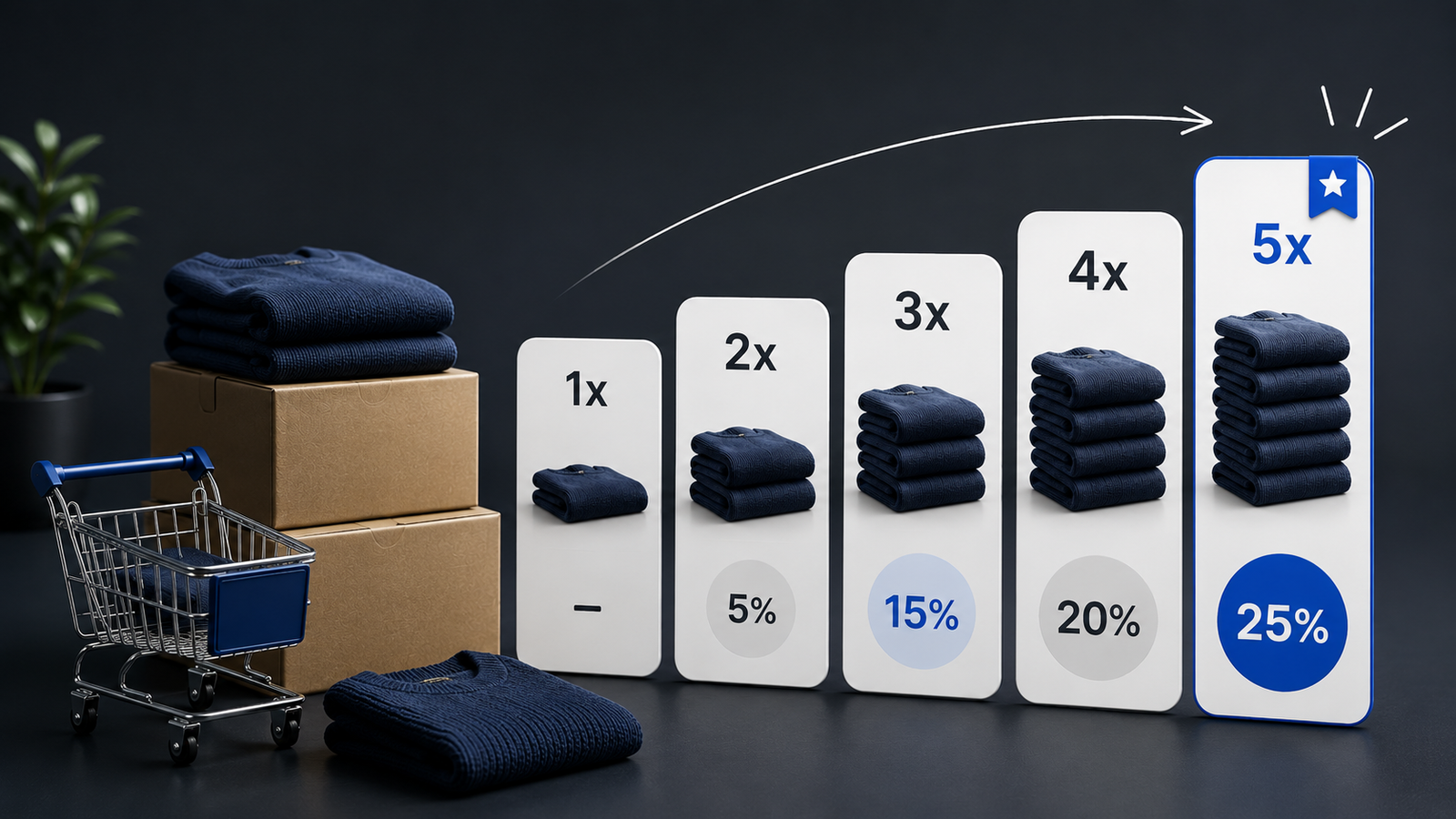
“Buy three and save 15 percent.” Few sales arguments are this easy to understand. Quantity discounts work because they offer customers an immediately recognizable benefit: the more they buy, the less they pay per unit. Many Shopware stores leave this potential untapped because the price advantage exists technically but is not presented convincingly.
In practice, the same pattern appears again and again: when discounts are displayed unclearly on the product page, the savings simply disappear from view—and valuable revenue disappears with them. A quantity discount is only as strong as its presentation.
Key Takeaways
- Quantity discounts reward larger orders with a lower unit price and can significantly increase average order value.
- Presentation determines the outcome: if savings are communicated poorly, customers are more likely to abandon the purchase.
- Shopware supports native tiered pricing, but the traditional table layout is designed primarily for B2B use cases.
- Visual multipacks turn a plain pricing table into a clear and attractive purchase decision—especially on smartphones.
Many online stores fail to use the full potential. Shopware offers tiered pricing out of the box, but the standard presentation is often purely tabular and functional. That may be sufficient for business customers. In B2C, however, a traditional pricing table can quickly feel technical, confusing, and emotionally flat.
The product detail page determines whether a visitor buys, buys more, or leaves the store. An appealing quantity-discount option can make the decisive difference here. Instead of presenting dry pricing tiers, visual multipacks highlight package choices and savings. Our Shopware plugin “Quantity Discounts / Multipacks” is designed specifically to create this effect in B2C sales.
What Are Quantity Discounts and Tiered Discounts?
Quantity discounts reward customers for adding several units of a product to their cart. The larger the quantity ordered, the lower the price per unit. It is an e-commerce classic: volume discounts are among the most effective ways to increase average order value because customers actively choose the larger quantity.
A simple example:
- One unit costs €10.
- When buying three units, each product costs only €9.
- When buying five units, the unit price drops to €8.
This model works extremely well online. The crucial factor is its visual presentation. Today’s shoppers do not want to read tables, compare prices manually, and calculate which option offers the best value. They want to understand at a glance:
- Which quantity options are available?
- Exactly how much money will I save?
- Which option offers the best price?
- Which package is right for my needs?
The more intuitively these questions are answered, the lower the mental barrier before purchase.
Why Do Quantity Discounts Work So Well in B2C Commerce?
Quantity discounts appeal to several psychological buying motives at the same time. Targeted recommendations and intelligently assembled bundles can significantly increase order value because customers consciously choose a larger but more rewarding option. The discount provides the emotional trigger.
First, quantity discounts create the satisfying feeling of being economical. Customers feel that they are making a smart and forward-looking decision. They may spend more overall, but they get a genuine bargain per unit.
Second, multipacks reduce the risk of needing to reorder soon. This is a powerful argument for everyday products in particular. Customers who use a product regularly can build up a supply while also saving shipping costs and the effort of placing another order.
The Anchoring Effect Shifts the Purchase Decision
This is where the anchoring effect comes into play. When the regular single-unit price appears next to a clearly cheaper multipack, the larger package immediately seems disproportionately more attractive. The customer no longer asks whether to buy at all. The decision shifts entirely to which quantity to choose.
From a conversion perspective, that is the real gain: the purchase itself is no longer questioned. The difficult choice between “buy” and “do not buy” is subtly replaced by the more pleasant choice between “one unit” and “three units.” This shift in the customer’s mind explains why multipacks often convert much better than a simple discount code at checkout.
How Do Quantity Discounts Increase Average Order Value?
Alongside a strong conversion rate, one of the most important e-commerce goals is a high average order value. Every additional euro per order is valuable because it does not require expensive additional traffic. Quantity discounts increase precisely these metrics.
Suppose a customer plans to buy a single pack. On the product detail page, they see that buying three packs unlocks a substantial discount. If the benefit is presented clearly and attractively, the probability rises sharply that the larger package will land in the cart. The store generates noticeably more revenue from the same visitor.
Another advantage is that many order-related costs remain the same. Payment processing, packaging material, warehouse picking, and shipping are incurred whether one or three products are dispatched. A higher order value therefore improves not only absolute revenue but also the margin on each order. Used correctly, quantity discounts evolve from a nice promotion into a strategic growth lever.
Where Does Shopware’s Native Tiered-Pricing Display Reach Its Limits?
Shopware provides a functional tiered-pricing display out of the box. It is useful, but primarily targets factual, table-based use cases. The reason this can become a conversion killer in B2C is clear: when the price and discount disappear visually within the store design, or when the saving is not immediately recognizable as a percentage or euro amount, buyers leave.
The table format belongs in the B2B world. Business customers are accustomed to studying factual price lists, comparing purchasing quantities, and making decisions based on rational procurement processes.
B2C commerce follows different rules. Consumers scan websites and want to understand within milliseconds whether an offer is attractive. A plain table becomes an obstacle:
- It feels technical, rigid, and completely unemotional.
- Customers often have to calculate the actual saving themselves.
- The most attractive option—the “sweet spot”—is not highlighted visually.
- The offer does not feel like a special deal.
B2C customers expect highly intuitive user guidance. They do not want to calculate; they want to click. They do not want to analyze; they want to feel the benefit immediately. A quantity discount must therefore do more than exist technically—it needs to be presented with persuasive sales psychology.
Visual Multipacks Instead of Plain Pricing Tables
A modern multipack display transforms a boring pricing tier into a powerful sales argument. The foundation is visual: graphical presentation and badges guide shoppers much more effectively than plain text. What applies to high-resolution product images applies even more strongly to pricing.
Instead of abstract columns of numbers, stores can present clear, clickable packages:
- 1 unit – standard price
- 3 units – most popular choice, often highlighted in color
- 5 units – highest saving
This presentation changes perception completely. Customers see clearly separated purchase options. Subtle cues such as “Popular,” “Save 15 percent,” or “Best Price” act as signposts and remove the mental effort from the decision. The result is a smooth, modern shopping experience.
The benefits are clear:
- Quantity options are understood in a fraction of a second.
- Savings move positively into the foreground.
- The selection feels modern and encourages interaction.
- Customers are actively but gently guided toward larger quantities.
- Clickable cards are ideal for touchscreens and smartphones.
- The offer feels like a genuine promotion.
In short: visual design sells; tables merely inform.
Which Products Are Especially Suitable for Quantity Discounts?
Quantity discounts are a game changer for products that are used regularly, consumed, or frequently purchased in multiples. The rule of thumb is simple: the more predictable the consumption, the greater the potential. These categories are particularly well suited to multipacks:
Food and Beverages
Coffee, tea, snacks, soft drinks, spices, and shelf-stable specialty foods. Customers know they will need more. A value pack is the logical choice.
Cosmetics and Personal Care
Shampoo, creams, soaps, shower gel, and razor blades are purchased repeatedly. Quantity discounts encourage customers to prepare for the coming months immediately.
Pet Supplies
Pet owners are highly loyal and calculated buyers. Food, treats, and care products are classic consumables. Keeping a supply for a pet almost always makes sense.
Household Products
Cleaning products, laundry detergent, trash bags, and dishwasher tablets are continuously used. Value packs appeal to both price-conscious and pragmatic shoppers.
Nutritional Supplements
Whether vitamins, protein powder, or capsules, a one-month, three-month, or six-month supply can be packaged and communicated perfectly as a tiered offer.
Office, Hobby, and Consumable Supplies
Printer paper, labels, and pens often overlap with B2B purchases, but consumers also like to buy craft materials, yarn, and paint in cost-effective multipacks.
Why Clarity Determines Whether the Discount Works
A discount alone does not increase conversion—communication does. This is the biggest pitfall: if the saving is not shown clearly as a percentage or a specific monetary amount, its effect disappears. Customers need to understand within the first second what they receive and why the offer is worthwhile.
An excellent quantity-discount presentation answers three questions immediately:
- How many products will I receive?
- What will I pay in total or per unit?
- How much will I save compared with buying individual units?
The more transparently these facts are presented, the greater the trust. The decisive factor is the visualized saving. Examples that work immediately include:
- “You save 10%”
- “€5 cheaper”
- “Best unit price”
- “Most popular option”
- “Ideal for 3 months”
Microcopy like this dramatically reduces cognitive load and practically guides the customer’s finger toward the Add to Cart button.
Our Shopware Plugin “Quantity Discounts / Multipacks”
We developed our plugin with one clear goal: to present quantity discounts in Shopware in an extremely attractive and fully B2C-focused way. It brings quantity tiers out of the technical background and places them as high-converting visual cards directly on the product page.
This transforms traditional tiered-pricing logic into a powerful sales tool on the product detail page. The module is ideal for store operators who want to:
- increase their average order value.
- sell consumables or refill products.
- present package sizes and bundles in an appealing visual format.
- replace Shopware’s native table with something more engaging for consumers.
- optimize their product detail pages uncompromisingly for conversion.
The plugin is available directly from the Shopware Store and can be ready to use in just a few clicks.
The Product Page Is Your Digital Sales Advisor
E-commerce lacks the sensory cues of physical retail. There are no huge red promotional signs in the aisle, customers cannot touch the product, and there is no skilled sales associate recommending the family pack. The screen has to carry that entire burden. As mobile devices now account for the majority of shopping traffic, success depends on clarity within just a few square inches of display space.
Your product detail page is your best salesperson. It needs to inform, provide orientation, and ultimately close the deal. Quantity discounts must not be hidden as a footnote; they need to shine prominently as a top offer. A visual selection of quantities tells customers: “This is the standard,” “Most people choose this,” and “This gives you the best value.” Simple decisions consistently lead to more purchases.
How Do Multipacks Improve the Conversion Rate?
The conversion rate does not rise magically simply because the word “discount” appears somewhere on the page. The real impact comes from combining genuine customer value, flawless design, and optimal user guidance. An excellent module consistently removes friction from the buying process:
- Minimal mental effort: Nobody needs calculator-level gymnastics to find the best deal.
- Maximum appeal: A highlighted value pack immediately creates desire.
- Positive framing: Instead of “Buy or leave?” the question becomes “One pack or three?”
- Clear incentive to save: The prominently displayed saving justifies the higher total spend.
- Strong trust: Transparent, accurately displayed prices look professional and trustworthy.
The result is that significantly more visitors become paying customers, and those customers are more willing to spend larger amounts.
Quantity Discounts Without an Unnecessary Price War
Permanent discounts have a questionable reputation in e-commerce because they destroy margins and can train customers to become bargain hunters. Quantity discounts operate in a completely different category.
The price advantage is always tied to a concrete contribution from the customer: purchasing a higher quantity. You are not giving away margin across the board. In return, you gain a higher cart value and lower relative logistics costs. It is a fair trade-off: the customer enjoys a lower unit price, while the merchant benefits from a stronger contribution margin per order.
Clean calculations remain essential. The discount needs to be noticeable enough to trigger the purchase impulse without undermining profitability. Small price advantages are often sufficient when they are presented exceptionally well.
How to Use Quantity Discounts Effectively
Quantity discounts need a small strategy to deliver their full impact. These six principles have proven effective:
- Choose the right products: Focus on consumables or bestsellers that customers need repeatedly.
- Less is more: Do not offer five different quantity tiers. Three options—single, medium, and large—are usually the conversion sweet spot.
- Frame the bestseller: Mark the middle package as “Our Recommendation” or “Bestseller” to guide undecided shoppers.
- Make the saving prominent: Display the discount clearly, for example “You save €5.” Do not hide the benefit in body copy.
- Mobile first: Test carefully whether the cards are easy to tap with a thumb on a smartphone.
- Test, test, test: Try different discount levels and labels. Monitor how average order value and margin develop.
Shopware Expertise Meets Conversion Optimization
A successful online store is much more than correctly installed code. The real leverage lies in the perfect combination of technology, UX design, and sales psychology.
As an experienced Shopware agency, we do not only ask, “Does it work technically?” We ask, “Does it generate more revenue for the store operator and create a better experience for the customer?” Our “Quantity Discounts / Multipacks” plugin emerged from this mindset. We repeatedly saw that Shopware’s native tiered-pricing function calculates reliably but that its table layout fails to connect with emotionally driven B2C buyers.
B2C stores need solutions that inspire, look compelling, and work instantly. The result is a presentation that does not merely display savings but actively sells them.
Frequently Asked Questions About Quantity Discounts in Shopware
What Is the Difference Between Quantity Discounts and Tiered Discounts?
They mean essentially the same thing: the more customers buy, the less they pay per unit. “Tiered discount” focuses linguistically on the pricing levels or table, while “quantity discount” feels more benefit-oriented and emphasizes the advantage of buying more.
Why Is the Visual Presentation So Important?
Because confusing pricing can lead directly to purchase abandonment. Customers do not have the time or desire to work out the benefits themselves. Visual cards make quantities, prices, and savings understandable within milliseconds and speed up checkout.
Which Stores Benefit From a Multipack Plugin?
It is an essential feature for B2C stores selling consumables, food, cosmetics, pet supplies, or nutritional supplements. Hybrid B2C/B2B stores, such as office-supply retailers, also benefit when consumers begin purchasing in larger quantities.
Can Quantity Discounts Really Increase Average Order Value Noticeably?
Absolutely—that is their primary purpose. When the offer is positioned well, a surprising number of customers spontaneously choose the medium or large package. This increases revenue per order while fixed shipping costs remain unchanged.
Should I Enable Quantity Discounts for Every Product?
No. Multipacks do not make sense for one-time, high-priced purchases such as a television. Use this lever selectively for products that are consumed and need to be purchased again.
How Many Options Should I Offer Customers?
The golden rule is three tiers: a single option, an attractive value package—the sweet spot—and a large stock-up package. More options create analysis paralysis; customers cannot decide and may buy nothing.
Where Can I Buy the Plugin?
The “Quantity Discounts / Multipacks” plugin is available from the official Shopware Store and integrates seamlessly into your existing store.
Conclusion: Sell More Without Complicating the Buying Process
Quantity discounts are one of the most elegant and effective strategies for encouraging customers to place larger orders. The deal is universally understood: buy more and pay less per unit.
For this mechanism to work in B2C, the offer needs to catch the eye. A gray tiered-pricing table hides your strongest sales arguments, and unclear discounts cost real revenue every day. A modern visual multipack display turns abstract numbers into clickable, highly attractive offers. It removes the need for calculations, puts the saving in the spotlight, and naturally guides the purchase decision toward a larger cart.
This is where enormous conversion potential lies. With the Shopware plugin “Quantity Discounts / Multipacks”, you can present offers in a modern, conversion-optimized, and highly user-friendly way. Replace boring tables and turn your pricing tiers into impossible-to-miss sales arguments.